Log In

Hemp-derived Delta-9 THC edibles and beverages remain legal in Texas for adults 21+ as of August 26, 2026, at or below 0.3% Delta-9 THC by dry weight.
Across 16 in-stock Delta-9 products priced on August 26, 2026, costs ranged from $0.019 to $0.998 per milligram of Delta-9 THC.
Baked goods were the lowest-cost format per milligram in this sample. Ready-to-drink beverages were the highest.
Commonly reported onset for oil-based Delta-9 edibles is 30 minutes to 2 hours, with duration often described as 4 to 12 hours.
Section 781 of P.L. 119-37 caps finished hemp products at 0.4 mg of total THC per container, effective November 12, 2026, unless the House enacts a Senate-passed extension to December 11, 2026.
Table of Contents:
- What is the difference between a THC drink and a THC edible?
- Which THC format costs the least per milligram?
- How long do Delta-9 gummies take to kick in?
- Do THC drinks work faster than edibles?
- Is 10mg of Delta-9 a lot?
- What do the numbers on a THC label actually mean?
- Why is the container total about to matter more than the serving?
- Which format makes more sense for you?
- Frequently Asked Questions
What is the difference between a THC drink and a THC edible?
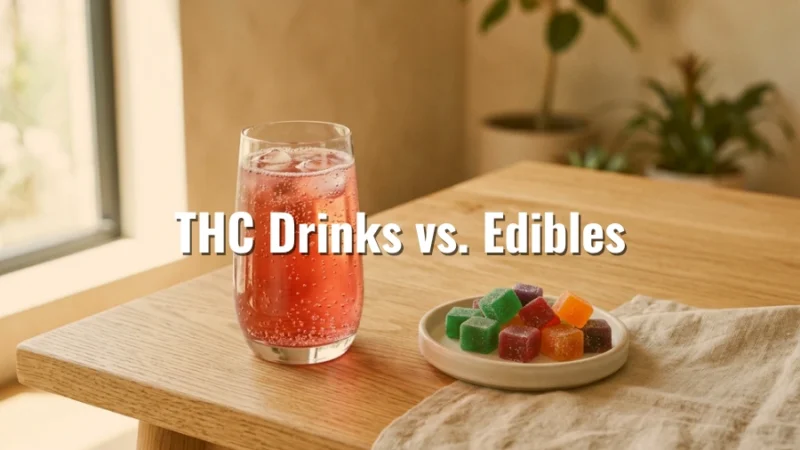
A THC drink and a THC edible differ primarily in how the THC is carried. Most Delta-9 gummies, chocolates, and baked goods carry THC in an oil or fat base. Most modern Delta-9 beverages use a nano-emulsion, in which the THC is processed into microscopic droplets suspended in water. Both formats deliver Delta-9 THC, and both are legally edibles; they differ in physical form, in commonly reported onset timing, and — as the pricing below shows — substantially in cost per milligram.
| Oil-based edibles | Emulsified beverages | |
| Carrier | Fat or oil base | Water-soluble nano-emulsion |
| Reported onset | 30 minutes to 2 hours | Commonly shorter; varies by product |
| Reported duration | 4 to 12 hours | Commonly shorter |
| Serving control | Fixed per piece | Fixed per can; higher in mix-in formats |
| Common label unit | mg per piece | mg per can |
| Cost per mg (this sample) | $0.019 – $0.250 | $0.117 – $0.998 |
| Shelf stability | Room temperature | Often refrigerated |
Onset and duration figures are commonly reported ranges, not guaranteed outcomes. Individual results vary.
Which THC format costs the least per milligram?
Baked goods cost the least per milligram of Delta-9 THC in this sample, and ready-to-drink beverages cost the most. We priced 16 in-stock Delta-9 products at D8 Austin on August 26, 2026, dividing the current listed price by the total labeled milligrams of Delta-9 THC in the package.
The spread is larger than most shoppers assume. A 5mg Delta-9 seltzer at $4.99 works out to roughly $1.00 per milligram. A 1000mg bag of Delta-9 baked bites at $18.99 works out to roughly $0.019 per milligram. That is a difference of about 52 times for the same cannabinoid.
| Product | Format | Total D9 | Price | Cost per mg |
| Binoid Chocolate Chunk Bites | Baked | 1000mg | $18.99 | $0.019 |
| Binoid Blueberry Muffin Bites | Baked | 1000mg | $18.99 | $0.019 |
| Binoid Mini Brownie Bites | Baked | 500mg | $18.99 | $0.038 |
| Torch High Potency Seltzer 60mg | Drink | 60mg | $6.99 | $0.117 |
| Herban Bud Caramel Taffy | Taffy | 300mg | $34.99 | $0.117 |
| Hometown Hero Chocolate Chip Cookie | Baked | 50mg | $5.89 | $0.118 |
| Erth Wellness Chocolate Bar | Chocolate | 100mg | $14.99 | $0.150 |
| Delta 9 High Spectrum Hemp Shot | Drink | 100mg | $14.99 | $0.150 |
| Wyld Uplifting Gummies (30ct) | Gummy | 300mg | $54.99 | $0.183 |
| Delta 9 THC Hemp Soda | Drink | 100mg | $18.99 | $0.190 |
| Hometown Hero Agave Syrup | Syrup | 120mg | $24.99 | $0.208 |
| Wyld Uplifting Gummies (10ct) | Gummy | 100mg | $21.99 | $0.220 |
| Hometown Hero Key Lime Pie Gummies | Gummy | 420mg | $98.00 | $0.233 |
| Torch High Potency Seltzer 25mg | Drink | 25mg | $5.99 | $0.240 |
| Ganja Chews Delta-9 Gummies | Gummy | 100mg | $24.99 | $0.250 |
| DELTA Cannabis Water | Drink | 20mg | $5.99 | $0.300 |
| 3CHI Delta-9 Seltzer 5mg | Drink | 5mg | $4.99 | $0.998 |
Methodology: current listed price divided by total labeled Delta-9 THC per package, as of August 26, 2026. Sale prices used where in effect. Products combining Delta-9 with other cannabinoids were excluded so the comparison stays like-for-like. Prices and availability change; the product listing governs.
Cheapest per milligram is not the same as best value, and it would be misleading to present the table as though it were. When you buy a 5mg seltzer, you are buying a 355ml carbonated beverage, its packaging, and its cold-chain handling — the cannabinoid is a small part of what you paid for. The same logic applies to a single-serve cookie versus a twenty-count bag. What the table actually tells you is that format, not brand, is the dominant driver of per-milligram cost in this category, which is not obvious from any product page and is the number almost nobody calculates before buying.
How long do Delta-9 gummies take to kick in?
Commonly reported onset for an oil-based Delta-9 gummy is 30 minutes to 2 hours, with duration often described as 4 to 12 hours. Those ranges are wide because onset and intensity vary considerably between individuals and between occasions for the same individual, driven by ordinary variables: whether you have eaten recently, what you ate, body composition, tolerance, and metabolism.
The two-hour tail on that onset window is the number that matters most for someone new to the format, because two hours is longer than most people’s patience. The common pattern is a second serving at the forty-five-minute mark, followed by both arriving together. Nothing malfunctioned in that scenario. The label described a range, and the consumer read it as a promise.
The practical response is unglamorous. Take the smallest labeled serving, let the full onset window pass before considering more, and treat a first experience with any new product as calibration rather than as the experience itself.
Do THC drinks work faster than edibles?
Manufacturers of nano-emulsified Delta-9 beverages generally describe faster onset and shorter duration than oil-based edibles, because the THC is dispersed as fine droplets in water rather than carried in fat. The mechanism is plausible, since droplet size and water solubility affect absorption. The evidence is weaker than the marketing: independent comparative data across brands is limited, emulsion quality varies widely between manufacturers, and the individual variability that applies to edibles applies here too. Treat faster onset as a design intent rather than a guarantee.
Where the difference is practically useful is feedback timing. A shorter gap between consuming and noticing reduces the guesswork that leads people to double up on edibles. That is an ergonomic property of the format, distinct from any claim about the experience itself.
Is 10mg of Delta-9 a lot?
Ten milligrams of Delta-9 THC is a moderate-to-strong single serving by current hemp market conventions, and it is more than a reasonable starting point for someone without established tolerance. Many in-stock Delta-9 beverages are formulated at 5mg per can precisely because 5mg functions as an entry-level serving, while gummies commonly range from 10mg to 40mg per piece.
There is no universal answer, and anyone offering one is guessing. Tolerance, body composition, recent food intake, and the format itself all move the outcome, and the same 10mg can land differently for the same person on different days. The defensible general guidance is to begin below where you think you should, allow the full onset window, and adjust across separate occasions rather than within one.
Anyone with a health condition or taking medication should speak with a healthcare provider before use. Nothing here is medical advice.
What do the numbers on a THC label actually mean?
Two numbers appear on nearly every hemp THC package, and shoppers routinely read the wrong one.
Milligrams per serving is the amount in one gummy, one can, or one measured pour. Milligrams per package is the bulk total across every serving in the container. A bag advertised at 400mg is not a 400mg dose — it is a container holding some number of pieces that sum to 400. Marketing leads with the larger figure because it reads as value, which leaves the division to the consumer. Compare per-serving amounts and per-milligram price, not the number on the front of the package.
Syrups make the distinction concrete because they are measured rather than counted. The in-stock agave Delta-9 syrup carries 120mg across the bottle, which the manufacturer breaks down to roughly 5mg per teaspoon and 15mg per tablespoon. A syrup is not inherently stronger than a gummy. It is a format where the serving is set by you rather than by the manufacturer, which cuts in both directions.
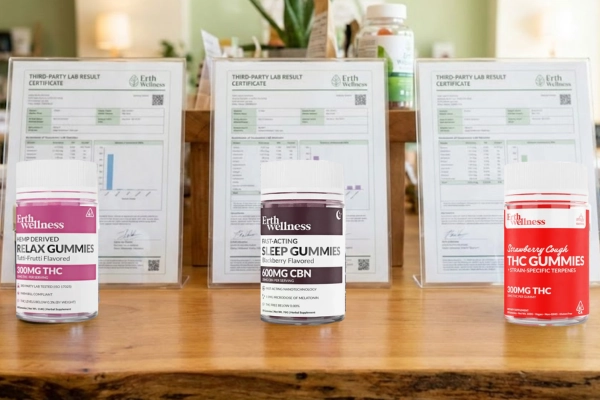
A third number is not on the label at all. The certificate of analysis reports what an accredited third-party lab measured in a specific batch, and it is the only way to check whether printed potency matches tested potency. Match the batch number on the report to the batch number on the package — a COA for a different lot describes a different product.
Why is the container total about to matter more than the serving?
Per-serving milligrams have been the only commercially significant number for years. That changes on a fixed date.
Section 781 of Public Law 119-37, the appropriations act signed November 12, 2025, rewrites the federal definition of hemp. It replaces the Delta-9-only threshold with a total-THC standard that folds in THCA and Delta-8 using the 0.877 conversion factor, and it caps finished hemp-derived cannabinoid products at 0.4 milligrams of total THC per container — where container means the innermost packaging holding the product for retail sale. Per container, not per serving. A ten-count bag is one container.
The date is contested; the standard is not. The Senate passed a continuing resolution on August 8, 2026, by a 90–6 vote that would move most of Section 781 to December 11, 2026. As of August 26, 2026, the House had not acted, so November 12 remains operative, and the exclusion covering cannabinoids that cannot be naturally produced by the plant takes effect November 12 under either version. A one-month extension changes neither underlying number.
One gap remains unresolved. Section 781 directed the FDA to publish a cannabinoid list and define “container” within ninety days of enactment, a deadline that fell February 10, 2026. Neither has been published, and Congressional Research Service analysts have noted the miss. Retailers holding multi-serving inventory still cannot determine with confidence how the rule applies to their own packaging.
For a shopper today, the practical takeaway is narrow but durable: the total on the package is a real number with legal consequences, not a marketing figure. Reading it is a habit worth forming regardless of which date the House settles on.
Which format makes more sense for you?
Neither format is better. They fail differently, and the pricing data clarifies the trade.
Baked goods and multi-count gummies deliver the most Delta-9 per dollar, are shelf-stable, and lock the serving at whatever the manufacturer chose. The long onset window is the cost of that convenience. Beverages deliver the shortest feedback loop and the most social format, at three to fifty times the per-milligram price and with refrigeration and bulk to manage. Syrups give the finest control over serving size and demand the most attention in exchange.
If you are new to Delta-9, pick the format you will actually measure carefully, start at the smallest labeled serving, and give it the full window. If you are buying regularly and cost matters, the table above is the fastest way to see what you are actually paying for the cannabinoid versus what you are paying for the packaging.
Browse current in-stock Delta-9 edibles, THC drinks, and syrup. Every listing links to its batch lab report, and all products are for adults 21 and over. Local pickup is available at our Austin store on West Parmer Lane.
Frequently Asked Questions
Which THC format is cheapest per milligram?
Across 16 in-stock Delta-9 products priced on August 26, 2026, baked goods were lowest at approximately $0.019 per milligram, and ready-to-drink beverages were highest, ranging to approximately $0.998 per milligram for a 5mg seltzer. Format was a larger driver of per-milligram cost than brand.
How long do Delta-9 gummies take to kick in?
Commonly reported onset for oil-based Delta-9 gummies is 30 minutes to 2 hours, with duration often described as 4 to 12 hours. These are ranges, not guarantees. Onset varies by individual, tolerance, and whether you have eaten recently.
Do THC drinks work faster than edibles?
Manufacturers of nano-emulsified beverages generally describe faster onset and shorter duration than oil-based edibles, because the THC is suspended in water rather than carried in fat. Independent comparative data across brands is limited, and emulsion quality varies, so treat it as design intent rather than a guaranteed difference.
Is 10mg of Delta-9 a lot?
Ten milligrams is a moderate-to-strong single serving by current hemp market conventions and more than a typical starting point for someone without established tolerance. Many Delta-9 beverages are formulated at 5mg per can as an entry-level serving. There is no universal answer, and individual results vary.
What does mg per package mean versus mg per serving?
Milligrams per serving is the amount in one gummy, can, or measured pour, and governs a single experience. Milligrams per package is the bulk total across all servings in the container. A 400mg bag is not a 400mg serving.
What is the 0.4 mg per container rule?
Section 781 of P.L. 119-37 caps finished hemp-derived cannabinoid products at 0.4 milligrams of total THC per retail container. It takes effect November 12, 2026, though a Senate-passed continuing resolution would move most of Section 781 to December 11, 2026 if the House concurs and the President signs.
Are Delta-9 edibles and drinks still legal in Texas?
Yes. As of August 26, 2026, hemp-derived Delta-9 edibles and beverages remain legal in Texas for adults 21 and over at or below 0.3% Delta-9 THC by dry weight. Delta-8, Delta-10, Delta-6, THCP, and THCA flower became Schedule I in Texas on July 31, 2026.