Log In
Two cannabinoids dominate the hemp shelves right now, and they couldn’t be more different in how they work. THCP delivers measurable potency from a fraction of a milligram. THCA does nothing at all until it meets a flame. If you’re trying to decide which one fits your needs in 2026, the answer depends on how you consume, what you want from a session — and what changes when H.R. 5371 takes effect on November 12.
Both face material legal status changes under the federal redefinition of hemp signed November 12, 2025, and Texas retail rules under 25 Texas Administrative Code Chapter 300 have already affected the in-store sale of THCA flower as of March 31, 2026. (Online ordering pathways remain available — we cover those separately in Texas Retail Ban Is In Effect — Still Available to Order Online.)
In this guide:
- The receptor-level science that explains why THCP works at sub-milligram doses
- Why THCA is sold in grams of flower while THCP is sold in milligram servings
- What H.R. 5371 actually changes for each cannabinoid
- A practical decision framework for shopping during the 2026 runway
Table of Contents:
- THCP vs THCA at a glance
- What is THCA, and how does it work?
- What is THCP, and what the receptor-binding data actually shows
- Side-by-side: effects, dosing, and onset
- Legal status in 2026: what H.R. 5371 changes
- How to choose during the 2026 runway
- Drug-test, safety, and tolerance considerations
- Frequently Asked Questions
- Bottom line: what to buy if you’re shopping May–November 2026
THCP vs THCA at a glance
| Attribute | THCP | THCA |
| Full name | Tetrahydrocannabiphorol | Tetrahydrocannabinolic acid |
| Psychoactive in raw form | Yes | No |
| Requires heat to feel effects | No | Yes (decarboxylation) |
| CB1 binding affinity (Ki) | ~1.2 nM | Negligible (binds only after decarb to Delta 9-THC) |
| Typical product formats | Vapes, gummies, blended carts, infused blunts, low-dose tinctures | Flower, prerolls, diamonds, raw tinctures |
| Typical serving size | 0.5–2 mg | Measured in grams of flower; finished serving ≈ Delta 9-equivalent post-decarb |
| Onset (inhalation) | 1–5 minutes | 1–5 minutes (post-combustion as Delta 9) |
| Federal status post-Nov 12, 2026 (H.R. 5371) | Likely excluded — synthesized + “similar effects” to THC | Affected — counted in 0.3% total THC redefinition |
The cleanest way to read this table: THCA is a precursor that doesn’t do anything to your CB1 receptors until heat converts it to Delta 9-THC. THCP is a cannabinoid that binds CB1 directly, with the highest in-vitro receptor affinity of any naturally identified phytocannabinoid. They are not comparable on a milligram-for-milligram basis because they live on completely different parts of the cannabinoid pharmacology curve. The right way to compare them is by format, by serving size, and by how each fares under the 2026 regulatory framework.
What is THCA, and how does it work?
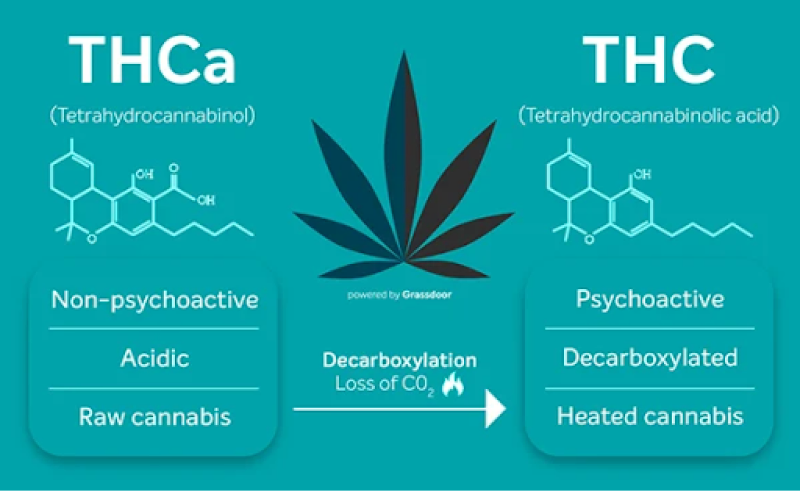
THCA — tetrahydrocannabinolic acid — is the dominant cannabinoid in raw, unheated cannabis. It has a carboxyl group attached to its molecular structure, and that carboxyl group is what prevents it from binding meaningfully to your CB1 receptors. Consume raw THCA and you won’t feel intoxicated; that’s why “raw” tinctures behave very differently from heated cannabis products.
Why THCA is non-psychoactive until heated
Heat removes the carboxyl group. The reaction is called decarboxylation, and the conversion to Delta 9-THC peaks at approximately 105–120 °C, per published thermal-conversion research (Wang et al., 2016). Once decarboxylated, the resulting Delta 9-THC binds CB1 receptors normally and produces the psychoactive effects associated with cannabis. The molar conversion factor most regulators use is 0.877 — meaning 1 gram of THCA, fully decarboxylated, yields roughly 0.877 grams of Delta 9-THC. (Above ~140 °C, conversion falls off as Delta 9-THC begins degrading to CBN.)
That conversion factor matters more than ever in 2026 because the federal government now uses it to calculate “total THC” for hemp compliance.
Why most hemp flower is sold as “THCA flower”
Under the 2018 Farm Bill (7 U.S.C. §1639o), hemp was defined by Delta 9-THC content alone — no more than 0.3% by dry weight. THCA was not counted. Plant breeders responded by developing cannabis cultivars that test below 0.3% Delta 9 while accumulating high concentrations of THCA. The result was the THCA flower category: a federally compliant raw product that, when smoked, behaves indistinguishably from traditional cannabis. This is why the hemp shelves in 2024–2025 looked like dispensary shelves. Same flower, different chemistry on paper.
For a deeper dive into THCA chemistry, formats, and lab analysis, see our complete THCA guide.
What is THCP, and what the receptor-binding data actually shows
THCP — tetrahydrocannabiphorol — was first isolated and characterized in 2019 by researchers at the University of Modena and Reggio Emilia. The paper, published in Scientific Reports (Citti et al., 2019), described a phytocannabinoid with a heptyl side chain — two carbons longer than the pentyl side chain of conventional Delta 9-THC.
The longer alkyl side chain
Side-chain length matters because of how cannabinoid receptors work. CB1 binding affinity is highly sensitive to alkyl chain length, and the Citti research measured THCP’s CB1 binding affinity at approximately 33-fold higher than Delta 9-THC in vitro (Ki ~1.2 nM vs. ~40 nM).
A precise read on this number: it’s binding affinity, not linear dose equivalency. THCP is not “33 times stronger per milligram” — that’s a colloquial shorthand that overstates what the science says. What the data shows is that THCP molecules occupy CB1 receptors at concentrations 33-fold lower than THC requires. In practical terms, that’s why a typical THCP serving is measured in tenths of a milligram while a typical Delta 9 serving is measured in 5–10 milligrams. But the scaling between in-vitro binding and in-vivo subjective effect is not linear, which is why responsible THCP products are dosed in the 0.5–2 mg range rather than at any fractional THC equivalent.
Where commercial THCP comes from
Trace amounts of THCP occur naturally in cannabis, but the concentrations are too low to extract economically. Most commercial THCP on the U.S. market in 2026 is produced by isomerizing hemp-derived CBD into THCP through controlled chemistry. The molecule is identical to plant-derived THCP, but the production pathway — synthesized outside the plant — is exactly what triggers one of the H.R. 5371 exclusions we cover below.
For the full breakdown of THCP, including manufacturing, dosing, and product formats, see our complete THCP guide.
Side-by-side: effects, dosing, and onset
The serving-size gap between THCP and THCA is the single most useful framing for new buyers.
Typical THCP serving (0.5–2 mg) vs. THCA flower bowl
A 1 mg THCP gummy is not equivalent to a 100 mg Delta 9 edible — they’re operating at different scales. The reason the milligram numbers are so different is the receptor-binding asymmetry described above. A reliable starting point for THCP is 0.5–1 mg for new users and 1–2 mg for experienced users; a THCA flower bowl, by contrast, is measured in grams of plant material that decarboxylates during combustion to deliver a Delta 9-THC dose comparable to traditional cannabis.
Duration and intensity differences
Users commonly report longer-feeling sessions from THCP than from comparable Delta 9 products, and a more pronounced ramp-up curve. Inhaled THCP typically produces effects within 1–5 minutes; inhaled THCA flower hits in the same window because once it’s decarboxylated by the flame, what’s reaching the bloodstream is Delta 9-THC. Edible THCP carries the same delayed onset as any oral cannabinoid (30–90 minutes), which is one reason low-milligram dosing matters: a higher-than-intended THCP dose can’t be unwound mid-session.
Why some products combine both
Because THCP and Delta 9-THC bind CB1 differently — and because the decarbed THCA in flower delivers a familiar Delta 9 profile — pairing the two formats can produce a layered onset and a longer sustained plateau than either alone. Combined-cannabinoid products (THCA flower with a THCP infusion) are now one of the fastest-growing format categories. We covered the rationale in detail in our Blazed THCA + Delta 9 + THCP guide.
Legal status in 2026: what H.R. 5371 changes
On November 12, 2025, President Trump signed Public Law 119-37, the Continuing Appropriations and Extensions Act of 2026. Section 781 of that statute fundamentally rewrites the federal definition of hemp. The provisions take effect on November 12, 2026 — one year after enactment.
Three specific changes drive the THCP-vs.-THCA decision for buyers shopping today.
The 0.3% total THC redefinition (affects THCA)
Under the new statute, hemp must contain no more than 0.3% total THC by dry weight, calculated as Delta 9-THC + (THCA × 0.877). This is a major shift from the 2018 Farm Bill, which measured Delta 9-THC alone. Most hemp flower currently marketed as “THCA flower” tests above 0.3% under this combined formula and will be reclassified as marijuana under federal law as of November 12, 2026.
The synthesized/manufactured cannabinoid exclusion (affects THCP)
The same statute excludes any cannabinoid that is “synthesized or manufactured outside the plant” from the federal definition of hemp. As described above, the bulk of commercial THCP in 2026 is produced via CBD-to-THCP isomerization — i.e., manufactured outside the plant. THCP appears to fall squarely within this exclusion.
The 0.4 mg per-container cap
H.R. 5371 also caps total THC at 0.4 milligrams per innermost retail container. The math here is brutal for the finished-product side of the industry: a 100-count gummy bottle, a 30-count beverage pack, or any multi-serving format containing measurable THC would exceed this cap many times over. Both THCP-containing products and THCA-derived products fall under this constraint.
FDA’s missed February 10, 2026 deadline
H.R. 5371 also gave the FDA 90 days from enactment — until February 10, 2026 — to publish (a) a list of cannabinoids with “similar effects” to THC (which would be excluded from hemp regardless of synthesis pathway) and (b) a definition of “container” for the 0.4 mg cap. As of February 19, 2026, neither had been published, per reporting from Marijuana Moment. That ambiguity is part of the buyer decision: a key piece of how the THCP rule actually works in practice is still pending federal guidance.
Texas-specific timing
Texas adopted federally aligned total-THC methodology under 25 Texas Administrative Code Chapter 300, effective March 31, 2026, restricting in-store retail sale of smokable hemp that exceeds the 0.3% total THC calculation. Online and curbside pickup pathways remain available for Texas residents — see Texas Retail Ban Is In Effect for operational details.
This is not legal advice. It is what the statute and regulations say. Enforcement priorities, FDA rulemaking, and pending litigation may all shift the practical landscape between now and the November 12 federal effective date.
How to choose during the 2026 runway
Given the framework above, the buying decision in May–November 2026 comes down to four practical questions.
If you want flower-style sessions: the THCA pathway
THCA flower remains the closest hemp-derived product to traditional cannabis. If your preferred format is a bowl, joint, or vaporizer with whole flower, the THCA category is built for you. Browse current THCA inventory. Texas residents — see the linked retail ban update above for the online ordering pathway.
If you want intensity in a small format: the THCP pathway
THCP carts, gummies, and tinctures are the right move if you want measurable potency without burning flower. Start at 0.5–1 mg if you’ve never tried THCP. Move to 1–2 mg only after you understand how your body responds. Browse current THCP inventory and across the vape and edibles categories.
If you want both: combined-cannabinoid formats
The clearest combined-format example in our catalog is the Mellow Fellow 2G THCP Infused Blunts ($29.99) — a 2-gram THCA hemp flower base infused with THCP, in six strains across indica, sativa, and hybrid genetics (Cereal Milk, Ice Cream Mintz, Kali Mist, Mellow Kush, Super Boof, Yoda OG). The Kali Mist COA, for example, reports approximately 13.9% total cannabinoids with measurable Delta 9-THCP alongside the decarbed Delta 9-THC produced by the THCA base (lab results folder, KCA Laboratories ISO/IEC 17025:2017 accredited). The blunt wrap produces a slower, more even burn than a standard preroll, sustaining the layered onset across a longer session. This is not a beginner product — start with one or two small pulls and pause to assess. (Cart-format alternative: Blazed THCA + Delta 9 + THCP.)
Storage during the runway
If you’re planning purchases that will be consumed across the next several months, storage matters. Cannabinoids degrade with light, heat, and oxygen exposure — see our guide to storing hemp products long term for specifics by format.
Drug-test, safety, and tolerance considerations
Both THCP and THCA-derived products carry a drug-test positive risk. Standard immunoassay drug screens used in employment contexts detect 11-nor-Delta 9-THC-COOH, the primary urinary metabolite of Delta 9-THC. THCA flower, once smoked or vaporized, produces Delta 9-THC and its metabolites. THCP metabolizes through similar hepatic pathways and shares cross-reactivity with the same immunoassay panels. Neither cannabinoid is “drug-test safe” — not at low doses, not occasionally, not with any of the OTC flushing strategies marketed online.
General safety notes apply to both: dry mouth, increased heart rate, sedation (especially with indica-leaning THCA strains and higher THCP doses), and impaired coordination are common dose-related effects. Combining either cannabinoid with alcohol, benzodiazepines, opioids, or other CNS depressants increases the risk. Do not drive, operate machinery, or work in safety-sensitive environments after use. THCP, in particular, has minimal long-term human research relative to Delta 9-THC; the available data is concentrated in receptor pharmacology and animal cannabimimetic models rather than chronic-use observational studies in humans.
Frequently Asked Questions
Is THCP stronger than THCA?
THCP has approximately 33-fold higher CB1 receptor binding affinity than Delta 9-THC in vitro, per Citti et al., 2019. THCA is non-psychoactive in raw form and only produces psychoactive effects after it converts to Delta 9-THC through heat. Whether one is “stronger” depends on the comparison: per-milligram receptor binding, THCP wins by a wide margin. Pre-decarb activity, THCA produces no effects at all.
Does THCA convert to THCP when heated?
No. Decarboxylation converts THCA to Delta 9-THC, not THCP. THCP is a structurally distinct cannabinoid with a longer alkyl side chain — heat will not produce it from THCA.
Will THCP show up on a drug test?
Yes. THCP metabolizes through pathways that cross-react with the standard immunoassay panels used in employment and athletic drug screening. Both THCP and THCA-derived products carry positive-test risk and will not clear faster than traditional cannabis.
Are THCP and THCA still legal after November 12, 2026?
H.R. 5371 (Pub. L. 119-37, Section 781) excludes synthesized or manufactured cannabinoids from the federal hemp definition, redefines hemp at 0.3% total THC including THCA, and authorizes the FDA to designate cannabinoids with “similar effects” to THC for additional exclusion. Both face material restrictions effective November 12, 2026. The FDA missed its February 10, 2026 statutory deadline to publish the cannabinoid list, so the exact federal classification of THCP remains unresolved as of this writing.
Can I still order THCP and THCA in Texas after March 31, 2026?
The Texas DSHS rule under 25 Tex. Admin. Code Ch. 300 took effect March 31, 2026 and restricts in-store sale of smokable hemp. Online ordering and curbside pickup pathways remain available — see Texas Retail Ban Is In Effect — Still Available to Order Online for operational details.
Which should I buy if I want to keep options after the federal change?
THCA is hit by the total-THC redefinition; THCP is hit by the synthesized/manufactured exclusion and likely the FDA “similar effects” list when published. Both face restrictions through different mechanisms. Buyers prioritizing the runway often diversify across formats — flower for THCA, low-dose vapes or gummies for THCP, infused blunts for both — rather than concentrating in one category.

Bottom line: what to buy if you’re shopping May–November 2026
- Flower sessions: the THCA pathway, with online ordering for Texas residents post-March 31
- Intensity in a small format: the THCP pathway, starting at 0.5–1 mg
- Both, layered: a combined-cannabinoid format like the Mellow Fellow 2G THCP Infused Blunts above
The federal effective date is November 12, 2026, and the Texas DSHS retail rule is already in force. Choose the cannabinoid that matches how you actually want to consume — and the format that fits the runway you actually have.
References
- Citti C, Linciano P, Russo F, et al. (2019). A novel phytocannabinoid isolated from Cannabis sativa L. with an in vivo cannabimimetic activity higher than delta 9-tetrahydrocannabinol: Delta 9-Tetrahydrocannabiphorol. Scientific Reports, 9:20335. DOI 10.1038/s41598-019-56785-1.
- Wang M, et al. (2016). Decarboxylation study of acidic cannabinoids — peak THCA→ Delta 9 conversion 105–120 °C.
- 2018 Farm Bill, 7 U.S.C. §1639o.
- Pub. L. 119-37, Section 781 (Continuing Appropriations and Extensions Act, 2026), signed November 12, 2025; effective November 12, 2026.
- 25 Texas Administrative Code Chapter 300 (DSHS smokable hemp rule, effective March 31, 2026).
- Marijuana Moment, “FDA Misses Deadline To Publish Cannabinoid List And Define Hemp ‘Containers’…” February 19, 2026.